ClickHouse driver for sq
The recently-released sq v0.50.0
now has initial ClickHouse driver support. Much left to be done.
See the docs for details.
Major kudos to @drluckyspin for pushing on this for so long.
The recently-released sq v0.50.0
now has initial ClickHouse driver support. Much left to be done.
See the docs for details.
Major kudos to @drluckyspin for pushing on this for so long.
sq just had its 15 minutes of fame: briefly top item on
Hacker News.
It’s all downhill from here.
UPDATE: Well, not entirely downhill. Thanks to the HN post,
sqhas now passed 2k stars on GitHub.
Some enterprising soul recently added sq to
brew core.
So, you can now do brew install sq.
That’s a little snappier than the previous brew install neilotoole/sq/sq.
Much obliged, kind stranger.
It’s been a few months since I posted about sq, but a lot has been going on.
We’re now on sq v0.48.3, and the project
has passed 500 stars ⭐️ on GitHub.
The changes since the last sq post are too numerous to list here (see the extensive
CHANGELOG for details),
but some highlights include:
sq diff.
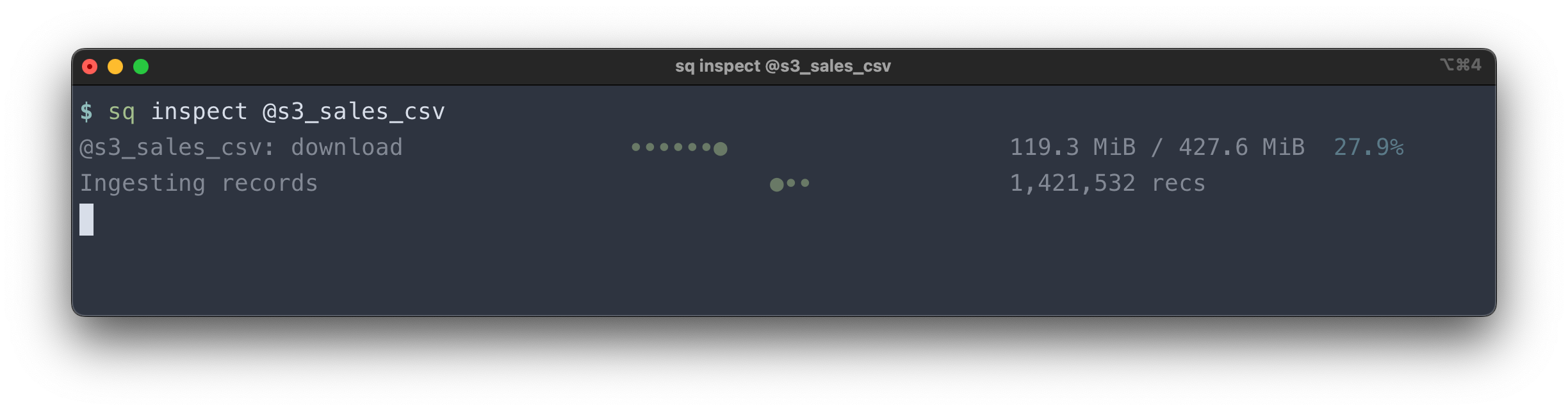
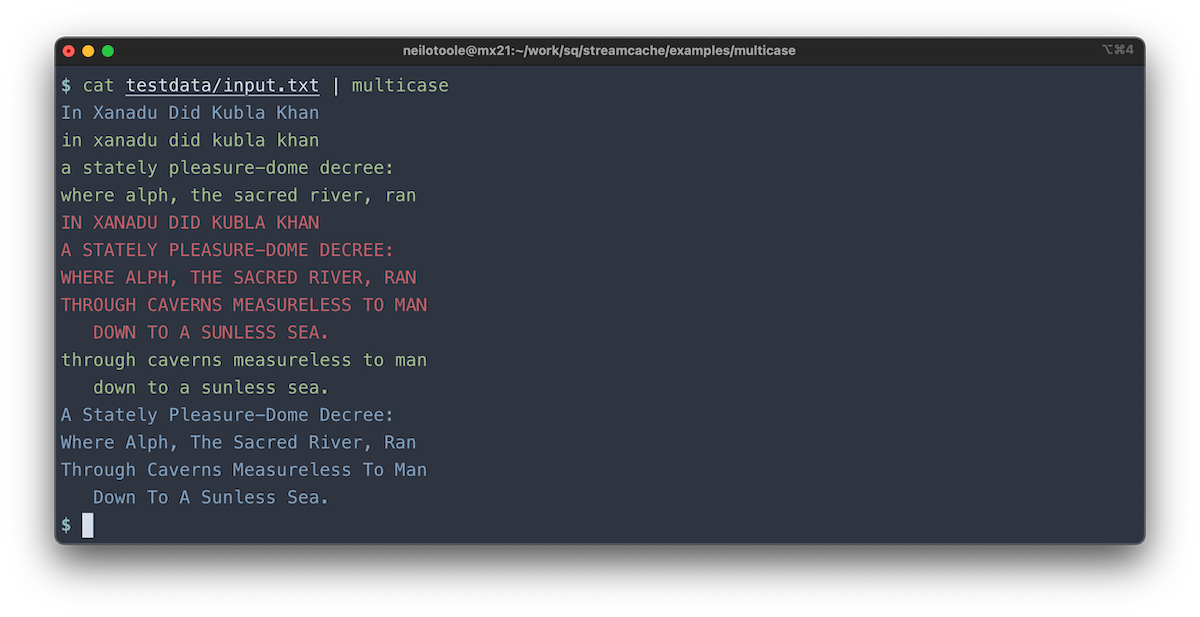
neilotoole/streamcache is a package I’ve had loitering
in the backlog for some time. I finally polished it off for use with sq, to
handle streaming from stdin or downloads. streamcache implements a Go in-memory byte
cache mechanism that allows multiple callers to read some or all of the contents of a source
io.Reader, while only reading from the source reader once. When only the final reader remains,
the cache is discarded and the final reader reads directly from the source. This is particularly
useful for scenarios where multiple readers may wish to sample the start of a stream, but only
one reader will read the entire stream.

Thanks to the efforts of Void Linux contributor @icp,
there is now a sq package
for Void Linux’s XBPS package manager.
# Update to get latest repo info
$ xbps-install -Syu; xbps-install -yu xbps
# Install sq
$ xbps-install -yu sq
# Run sq
$ sq version
sq v0.42.1
Or, just use the install script,
which detects Void Linux and calls xbps-install under the covers:
$ /bin/sh -c "$(curl -fsSL https://sq.io/install.sh)"
If you asked me to describe my (Go) developer toolchain essentials, I’d probably rattle off…
macOS, zsh, git & GitHub, Docker, Kubernetes & kubectl,
GoLand, golangci-lint,
and ngrok?
But sometimes you don’t appreciate things until they’re gone.
If you practice a tight feedback loop,
as I very much do, you could be running go test dozens or hundreds of times a day.
Overall, I find the Go testing framework to be lovely to work with, and I consider it an
integral part of the platform’s success. However, I feel that the default output format of go test leaves
a little to be desired. In large test suites, e.g. as might be seen
in a sq test run,
it’s burdensome to find test failures in the wall of output.
The -json format is even weaker: it’s just barely structured,
and feels like a low-effort addition to make the output technically JSON. But for
both of these formats, there’s already a whole tool ecosystem that depends on the current output
format details, so there’s little expectation of change.
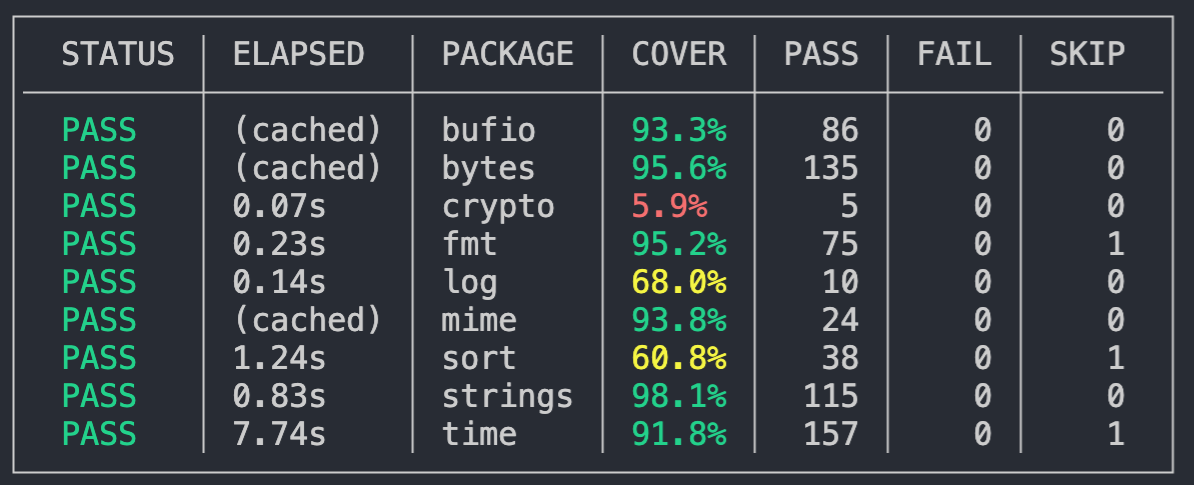
Enter tparse: it’s a wrapper around go test,
and I find its output much more suited to my local dev workflow. Give it a try.

The trigger for this post is that the most recent release of tparse panics on my
sq test run. I’ve filed a bug report, but for
now I’ve had to roll back to an older version of tparse. Hopefully that’ll be patched
up soon, but in the meantime: I 😍 you, tparse. Come back to me.
UPDATE 2023-11-18: The
tparseauthor has fixed the bug, and released v0.13.2, resolving the issue. Huzzah!
sq v0.41.0 has been published.
This release focuses heavily on improvements to Excel support, including:
Download via sq.io.
sq v0.40.0 is a
major release, with a completely rewritten join mechanism.
Previously, only a single join was supported, but now you chain as many
as desired.
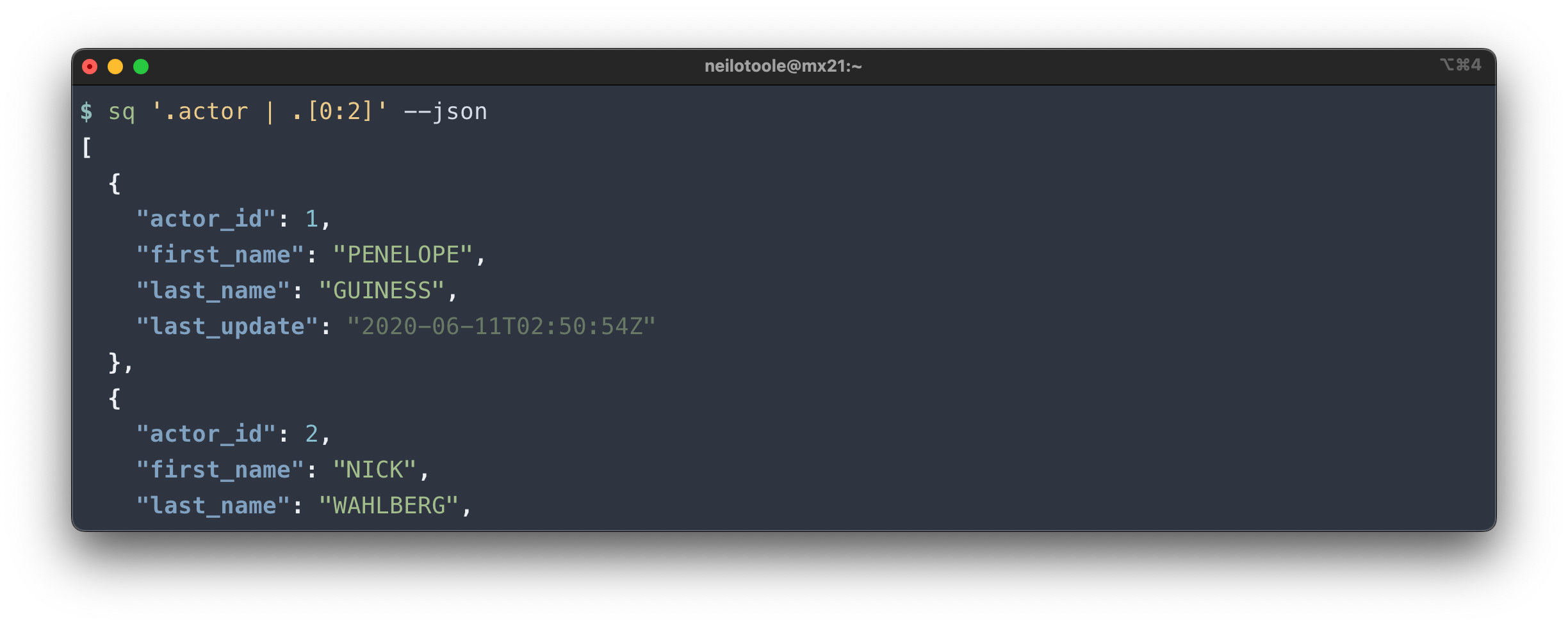
$ sq '.actor | join(.film_actor, .actor_id) | join(.film, .film_id) | .first_name, .last_name, .title'
There’s also support for the full family of join types (inner, left, right, cross, etc.).
Download via sq.io.
shelleditor is a tiny package I’ve put together
to call out to the system editor from within a Go CLI. Like most everybody in the Kubernetes ecosystem, I spend a lot of time
with the kubectl CLI,
and more time than I’d like doing kubectl edit X, to
directly edit k8s config for debugging.
Recently, I’ve been working on a complete overhaul of sq’s config
mechanism. I may have gone a little overboard.
sq is highly configurable, via flags, via its config file,
and via sq config set.
However, when making changes to a sq source, who can remember all the flags?
Yes, there’s shell completion for those flags, but there’s a lot of flags. Wouldn’t
it be easier to be able to see all the available flags in front of you, and
edit them as desired? Kinda like what kubectl edit does?
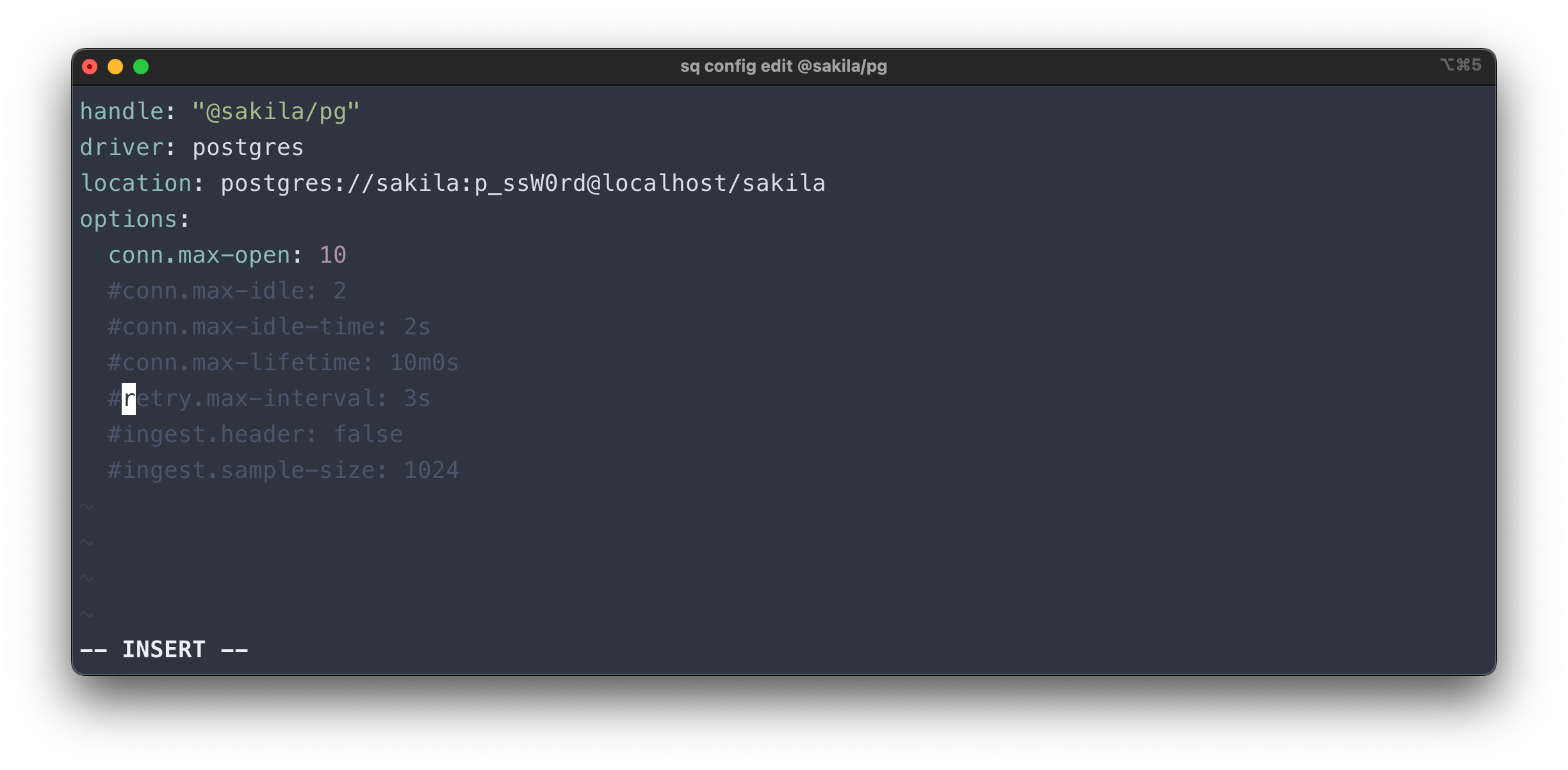
Enter sq config edit:

That idea’s inception led down a deep rabbit hole, worthy of its own post.
But for the purposes of this post, I had an immediate problem to solve: how
to call out to the system editor, e.g. vi. I found a standalone package,
tj/go-editor, but it didn’t seem to be
actively maintained, and anyhow, I was curious to see how kubectl did it. After eventually figuring out how to
navigate
the Kubernetes source code, I decided I may as well just lift the kubectl edit
implementation from them. Alas, a simple import pulled in an ungodly amount
of Kubernetes dependencies. So, I extracted the essentials, and the shelleditor
package was born.
Go 1.21 has a new structured logger in stdlib: slog.
I’ve been using the slog pre-releases in my projects for many months.
While there’s still a bit of a debate about the merits of its API, slog checks
enough boxes that it will become the standard. This eliminates a major hassle for
Go developers: needing to add bridges to various logging packages in order
to get a unified logging experience.
It also means I can formally retire my lg
experiment.
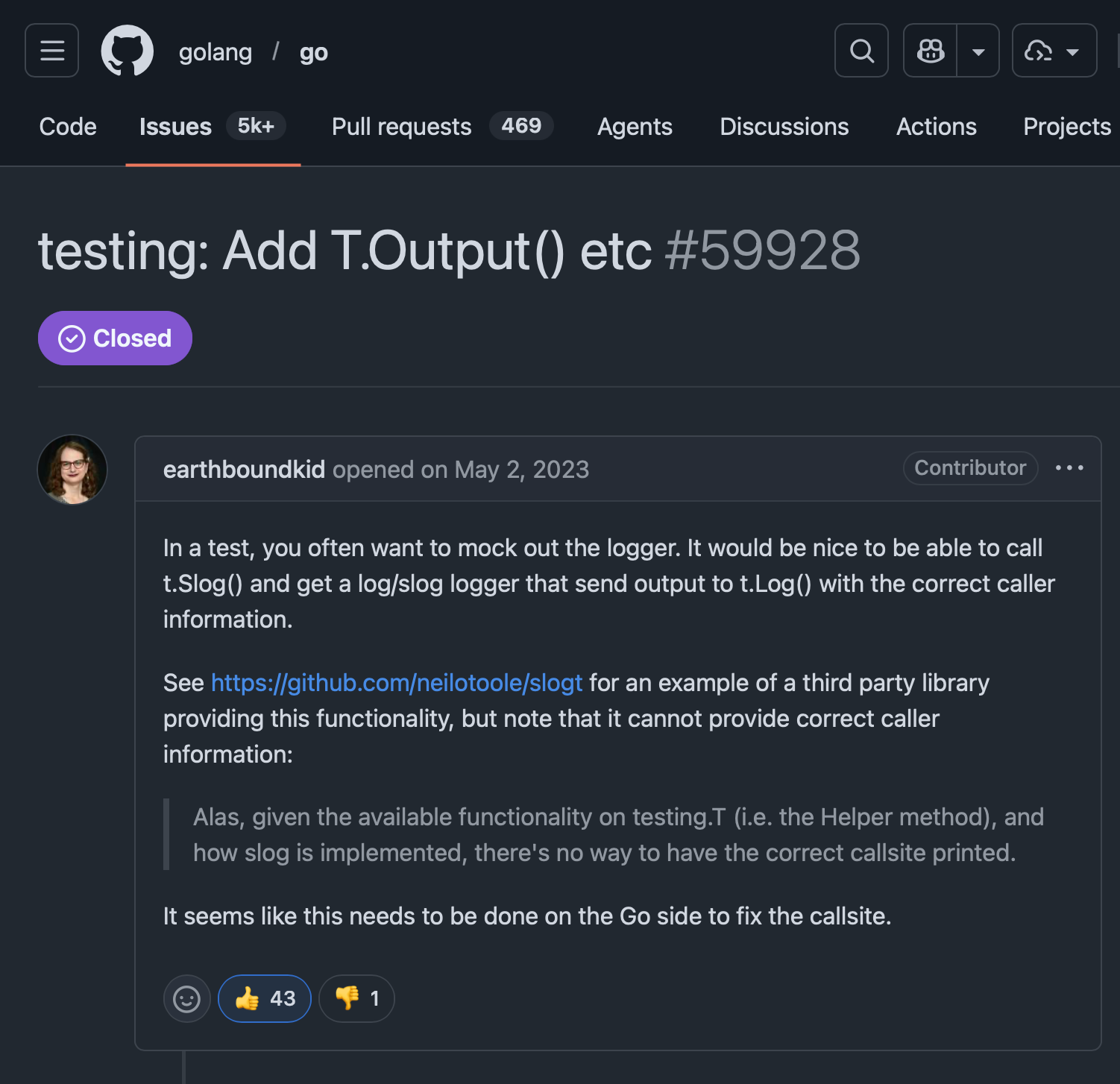
One aspect that the Go team have strangely neglected is that there’s no bridge
between slog and the stdlib testing package.
I created the slogt package as that
bridge. Hopefully something like this will one day be incorporated into stdlib,
and I can then retire slogt.
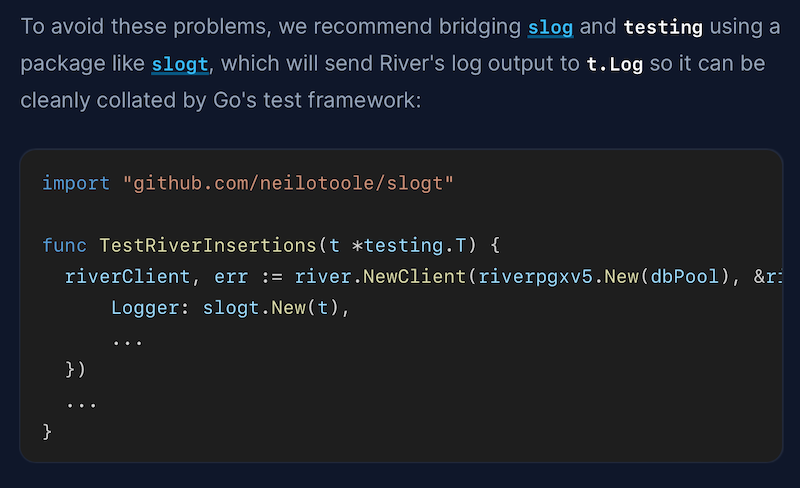
UPDATE 2024-03-15: I was recently looking through the docs for riverqueue, which is a Postgres-backed job queue for Go that I was investigating, and I saw this:
It’s gratifying to see that I’m not the only one who cares about correlating logs with tests!
I’ve recently been using asciinema on the sq.io docs site.
I found this Hugo module that makes it trivial to integrate asciinema.
{{< asciicast src="/telescope-repo-nvim/telescope.json" poster="npt:0:04" autoPlay=true loop=true theme="nord" >}}
One minor shortcoming was that it wasn’t possible to set default values, e.g. setting theme="nord" throughout
the site. One quick PR later, the author took care of that.
Very much relatedly, I wanted the Asciinema player to use the Nord theme. I ported Nord to an asciinema theme. It is mighty pretty.

However, it still requires a minor bit of config to use the theme. I’ve opened an asciinema player PR to bundle the Nord theme with the player. It’s only a tiny additional bit of CSS.
UPDATE 2023-04-15: That PR was merged to asciinema, so you should shortly be able to use the Nord theme directly from the asciinema distro.
There is now a sq package
for Arch Linux. Many thanks to Diego Souza
for creating this.
You can use your AUR-compliant package manager to install sq,
or simply use the install script,
which detects Arch Linux, and figures out which package manager to use.
$ /bin/sh -c "$(curl -fsSL https://sq.io/install.sh)"
One of the benefits of using jq is that it colorizes & prettifies
JSON output, making it much easier to parse visually. I wanted to do the same for sq,
which is written in Go. Looking around the existing libraries landscape, I found
several colorizing encoders, but each had shortcomings.
nwidger/jsoncolor does the trick, but performance is
egregious, due to it performing a re-parsing step.hokaccha/go-prettyjson and TylerBrock/colorjson
both colorize, but neither provide a stdlib-compatible Encoder implementation.So, I created neilotoole/jsoncolor, which ticks all
the boxes. It’s fast (faster than stdlib in many cases), configurable, and is a drop-in replacement
for the stdlib json package. I’ve already been using it in CLIs on client projects, and it works well.
Colorization is configurable. This is the color scheme I chose for sq, mimicking jq’s color palette.

I’m a big fan of the Go stdlib sync/errgroup package.
The errgroup.Group type makes it trivial to manage multiple worker goroutines that
all need to succeed, and often obviates the need for sync.WaitGroup.
However, both in personal and client projects, I regularly ran into the issue where I wanted to rate-limit the number of simultaneous goroutines. An example would be where the goroutines are calling a backend API (or DB) that itself has rate limits.
I created the neilotoole/errgroup package
as a drop-in replacement for stdlib errgroup. You use it like so:
import "github.com/neilotoole/errgroup"
func main() {
numG, qSize := 8, 4
g, ctx := errgroup.WithContextN(ctx, numG, qSize)
g.Go(func() error {
// do something
return nil
})
}
The numG and qSize params control the gating behavior of the Group. In
benchmarks, this implementation often outperforms stdlib errgroup, but obviously
take your own benchmarks for your specific workload.
UPDATE 2023-01-10: The Go team have updated
sync/errgroupwith aGroup.SetLimitmethod, which eliminates the need for my implementation (and their implementation is superior too). You should usesync/errgroupinstead; I’m happily retiringneilotoole/errgroup.
xcgo is a maximalist Docker image for cross-compiling and
releasing/distributing CGo-enabled Go/Golang applications. At this time, it can build and distribute
macOS, Windows and Linux CGo projects for arch amd64.
xcgo has what gophers crave:
go 1.14OSX SDK Catalina / macOS 10.15dockersnapcraftgoreleasergolangci-lintmagezsh and oh-my-zshStart at the neilotoole/xcgo repo, and
then head over to the wiki.
The neilotoole/xcgo images are published to Docker Hub.
There’s also a companion example project (neilotoole/sqlitr) that was
created explicitly to exhibit xcgo: it demonstrates pretty much the entire array of xcgo’s capabilities,
showing how to release to brew, scoop, snap, Docker Hub, GitHub, etc.
UPDATE 2023-09-22:
xcgowas created as a toolchain element forsq, with its many target architectures. At the time, there really wasn’t anything else that covered all the bases. However, recent releases of GoReleaser plus GitHub workflows are now able to satisfy the needs ofsq, and so off to the farm withxcgo. It’s still a totally viable project, but it requires a decent chunk of work to add Apple Silicon support, and ongoing work for each Go, OS, and misc tool release. That’s time I’d rather devote tosq
The first version of the lg package, released
years ago, was one of those rites of passage for Go devs: everybody needs to do
their own logger implementation at least once.
This v0.2 release has a legitimate purpose: it is an exploration of a small, leveled,
unstructured logging interface for enterprise applications.
lg delegates the actual log entry creation to backing libs
(such as uber/zap),
explores some idioms (log.WarnIfFuncError), and plays nicely with testing.T.
gohdoc is a command line tool that opens a package’s godoc in the browser. Use like this:
$ gohdoc . # open current dir godoc in the browser
$ gohdoc fmt # open pkg fmt
$ gohdoc encoding/jso # will open pkg encoding/json
This feels like one of those things that should be included in the Go toolchain. See the repo for more.
Back in the sq saddle after some downtime: sq v0.5.0 is now available.
Finally there’s conditional selects (basically, the SQL WHERE clause), and a number of other improvements.
Download via sq.io.
sq v0.4.0 is out. There’s a bunch of additional output formats in this release: Excel, CSV, TSV, and XML.
Download via sq.io.
sq v0.3.0 is done. The major new feature is the addition of the sq inspect
command, which provides metadata about the datasource (schema, tables, cols, etc).
Download via sq.io.
sq v0.2.1 is now available. There’s a bunch of bug fixes, but the big new feature
is cross-datasource joins (you can join an Excel spreadsheet with a MySQL DB, etc.)
Download via sq.io.
sq v0.1.11 is now available. This is a bug-fix release.
Download via sq.io.
I’ve just released techo, an Echo-based
alternative to Golang’s http.httptest. The genesis was trying to write automated
tests for generated (swagger-codegen) code, and I sometimes found
stdlib http.httptest to be tedious and verbose.
The value of this library is that writing tests is cleaner and
expressive with techo.
In my role at HPE, I’ve been doing a lot of work with Swagger,
in particular using the swagger-codegen
tool to generate Go clients from our
REST API’s swagger document. When I first started working with codegen, the Go
generator was pretty minimal (and in beta), and since then I’ve pushed several PRs
to the project. I’ll now be doing that in an official capacity: I’ve been invited
to be part of the Swagger Codegen Core Team,
specifically to look after the Go client generator.
I’ve been working a lot with the GitHub API of late, for the Go-based client I’m
building for HPE. One of the key elements for us (and for everybody else I assume)
is the GitHub auth infrastructure. So far, the go-github
lib has served us well, except that, for whatever reason, the entire auth API was
not implemented. From my perspective, that would have been the first thing I implemented,
but that was the situation.
I recently put together a small Drupal module that interfaces with Elastic Email, a mail relay service. That is, instead of your website sending mail via its own SMTP server, outgoing email is directed through the Elastic Email service and out onto the internet. This module provides plug n’ play integration with the Elastic Email service.
Believe me, this was not an easy thing to build, especially considering we’re supporting IE6. But I’m not shy about saying that this is one of the sweetest features I’ve ever seen built in-browser (and not using any Flash nonsense). It’s ahead of its time.
I’ve dug into a little PHP/Drupal work of late… not a huge fan of this ecosystem as it currently stands. It seems there’s a lot of simple things that should be done, that just aren’t done. This is my little contribution to that: a simple PHP global static caching library.
If you’ve read this far, you can read the rest over here.
Once upon a time, I was working on the assignment for the SCJD certification.
The project was a classic client-server application, with an RMI server, and a
Swing-based GUI, which you could use to book hotel rooms or some such. One of the
project requirements was to provide record locking, such that only one instance
of the client could edit the hotel room entry at once. Fairly standard stuff.
So, when the user clicks Edit Room in the client GUI, the client makes an RMI
call to acquireLock, and when that method returns, the client can then call
update, and so on. But if another client already has the lock, then the
acquireLock method will block until the lock becomes available. In that case,
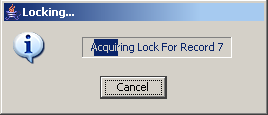
the app shows a pleasant dialog like this:

Obviously you, as the user, would like to be able to click Cancel.
And obviously you, as the developer, would like the RMI thread that’s stuck in
the remote acquireLock method to return promptly. But you, as the developer,
would be sorely disappointed, because the RMI thread will continue to block.
Indefinitely! And from this outrage, thus was born the Interruptible RMI library.
My years toiling away on web services seem to be paying off: I’ve been invited to be a member of the JCP Expert Group for JSR-261 (Web Services Addressing).
A primer:
This should be an interesting experience: I’m one of four individual contributors in the expert group, the rest of the members are representatives of their firms (Sun, Oracle, IBM, etc.). I’m informed that the expert groups can be a bit tetchy at times, we shall see how it pans out.
For the best part of the last year I’ve been an active contributor to some of
the Apache Commons projects (specifically Collections
and Lang). I’m now an official
committer at the ASF, with
write access to the VCS and what not. And a shiny @apache.org email address.
OK, so WSJ is Web Services Journal and not the Wall Street Journal, but still. This was a nice little surprise: even though I left Cape Clear a few months ago to move stateside, an article I submitted to Web Services Journal just got published in their print edition. Front page and all. The checkout guy at the Borders (an American bookstore) asked me why I was buying so many copies of the magazine, and then shook my hand and told me he’d “never met an author before”. My mother is very proud.
Little bit of deja-vu. It feels like I was just in Germany speaking at a conference only recently… This time I was in Frankfurt, at JAX2002 (JAX being Java Apache XML). I gave a talk on Web Services and the WSDL Design View, seemed to go down fairly well, although one of the (German) attendees told me afterwards that he had a bit of trouble with the accent. The feeling was mutual mein Freund!
Another trip to Germany, this time for Microsoft’s Visual Studio .NET launch event, in Karlsruhe. I gave a joint talk with my buddy Darius (from Microsoft) on Java/.NET web services interoperability. It was a bit nerve-racking, we were on stage in front of probably close to a thousand devs, and I could barely see the audience with the kleig lights pointed down at us. I’ll tell you this much, either the Microsoft events people have way too much money on their hands, or else they just plain love to have a good time. It was quite the show. And the .NET tools are pretty decent compared to what’s available in the Java world at the moment.
This is definitely not the worst thing about working for Cape Clear… I just came back from a trip to Munich to speak at the OOP2002 conference, where I was a member of panel discussing Web Services interoperability. Unfortunately they don’t seem to have any material from the conference online, so I’ll spare you the suspense re interoperability. The conclusion is: we’ll get there eventually!
Other conclusions: Munich is wonderful, the food is wonderful, the beer is wonderful. I could get used to that place.